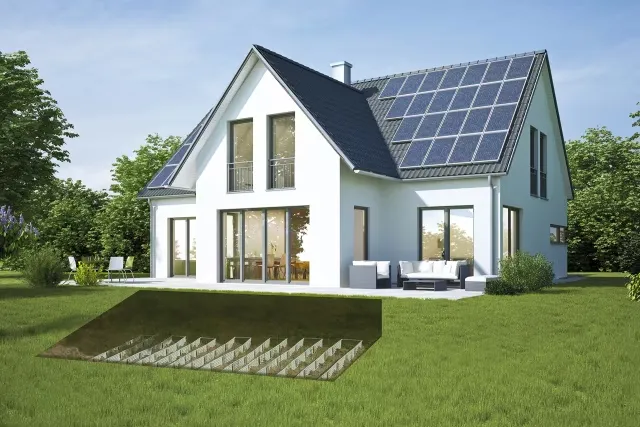

The earth is a vast, virtually inexhaustible heat reservoir and, at the same time, one of the most important heat sources. From a certain depth, the earth has a base temperature of approximately ten degrees Celsius. Compared to the surrounding air, this temperature is very constant. This means that even if the top layer of the earth is covered with ice, ground source heat pumps can continue to operate efficiently, as the difference between the heat source temperature and the flow temperature remains relatively small, even in winter.
How a brine/water heat pump works
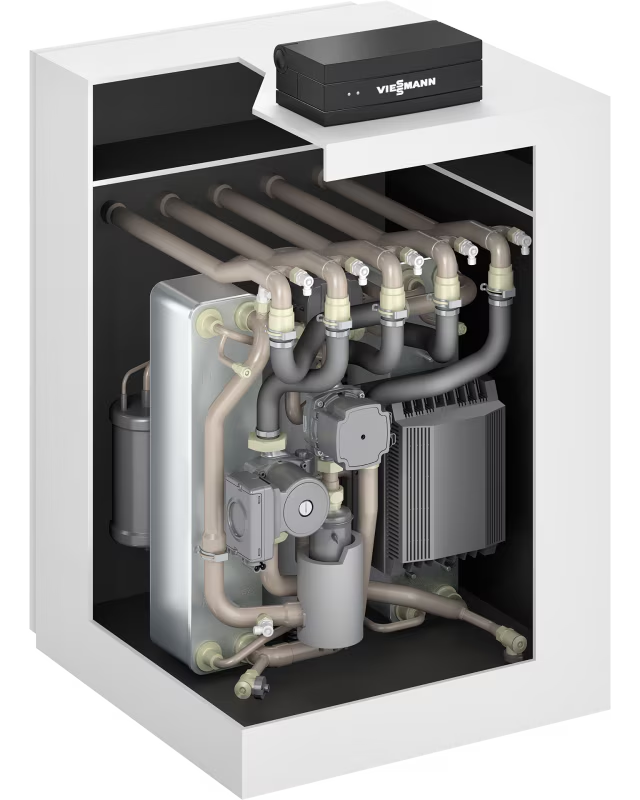
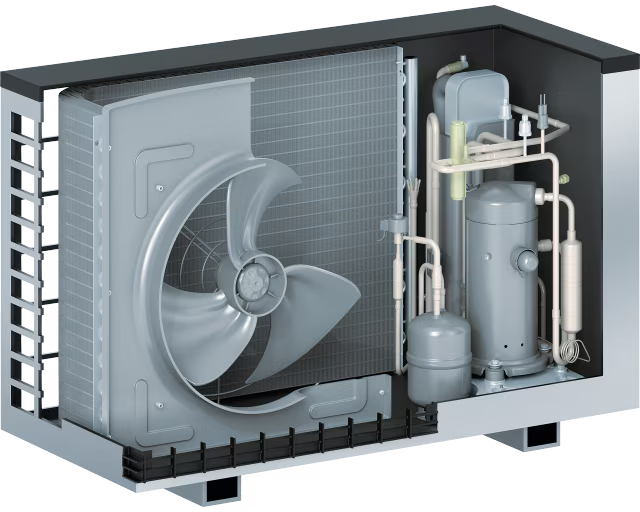
Like all other heat pumps, a brine/water heat pump operates on the same principle: First, thermal energy is extracted from the ground, which is then transferred to a refrigerant. This refrigerant evaporates and is further compressed by a compressor. This increases not only its pressure but also its temperature. The resulting heat is absorbed by a heat exchanger (condenser) and transferred to the heating system. You can learn more about this process in the article ” How a Brine/Water Heat Pump Works .”
In principle, geothermal heat can be extracted using a ground-source heat pump in two ways: either through geothermal collectors installed close to the surface or through geothermal probes penetrating the ground to a depth of up to 100 meters. In the following sections, we will examine both options.
Houses with Arnd Peiffer in the Tegernsee Valley
Perfection delights Arnd Peiffer. So it's only natural that the biathlete turned to his sponsorship partner, AHI-Carrier, to plan and install innovative technologies—a heat pump, a photovoltaic system, and an energy storage system—to power his new home.
Geothermal collectors are laid underground
To extract geothermal heat, a piping system is laid horizontally and serpentinely below the frost line. The depth is approximately one to two meters beneath the surface of the lawn or soil. A brine of frost-resistant liquid circulates within the piping system, absorbing thermal energy and transferring it to a heat exchanger. The required collector area depends, in part, on the heating requirements of a specific building. In practice, it is 1.5 to 2 times larger than the area to be heated. Geothermal collectors absorb thermal energy from the earth’s surface. This energy is provided by solar radiation and rainwater. Therefore, soil conditions play a decisive role in the collector’s energy output. It is important that the area above the piping system be free of asphalt or buildings. For more information on what to consider when installing geothermal collectors, see the article “Geothermal Collectors for Brine/Water Heat Pumps .”
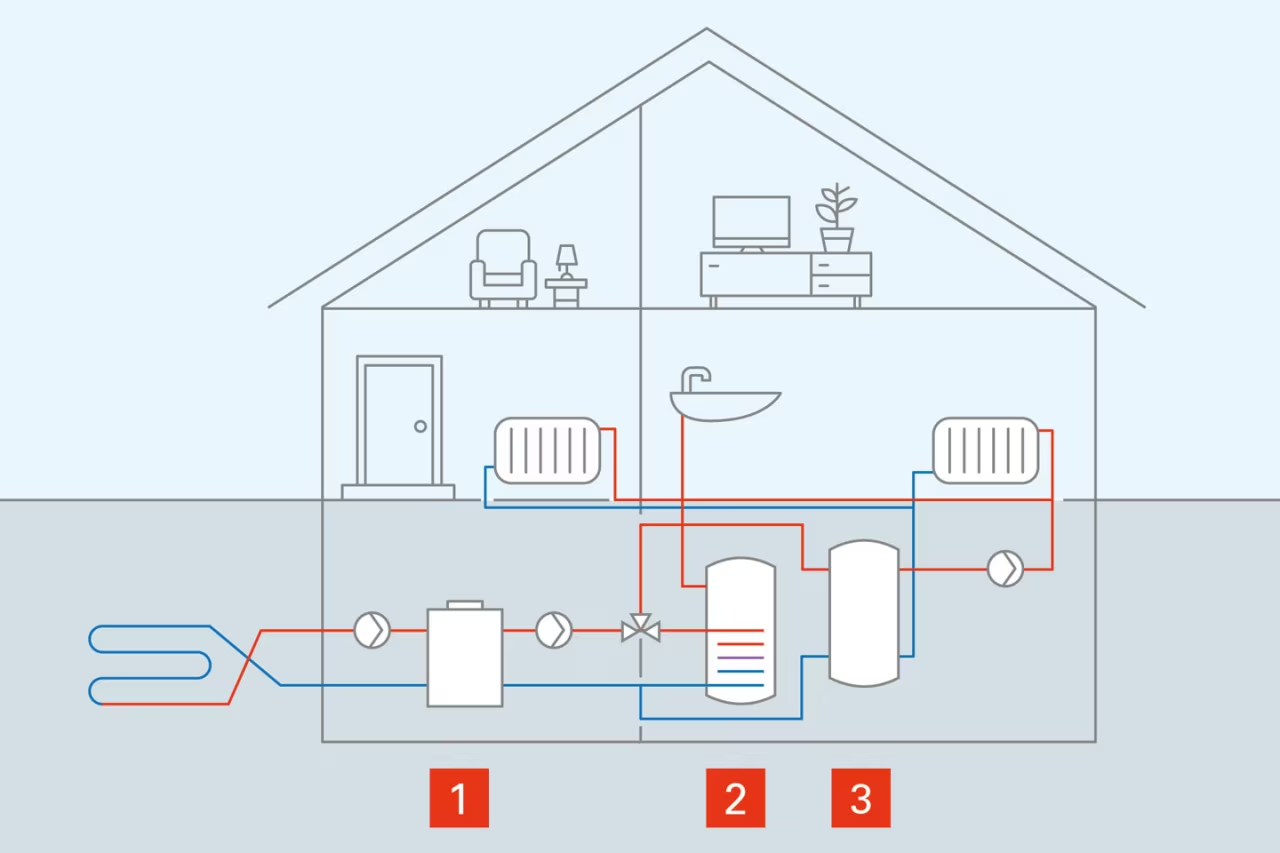
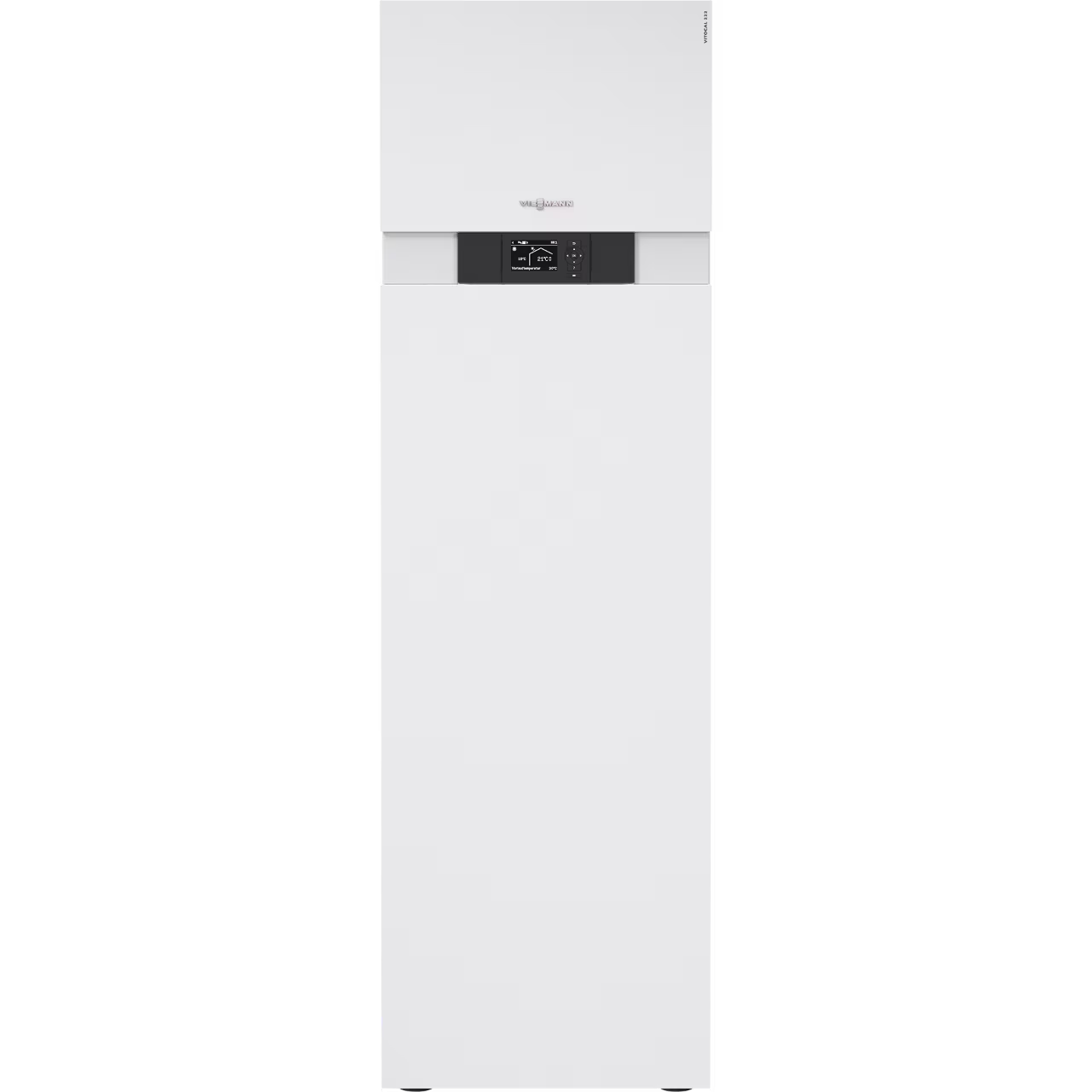
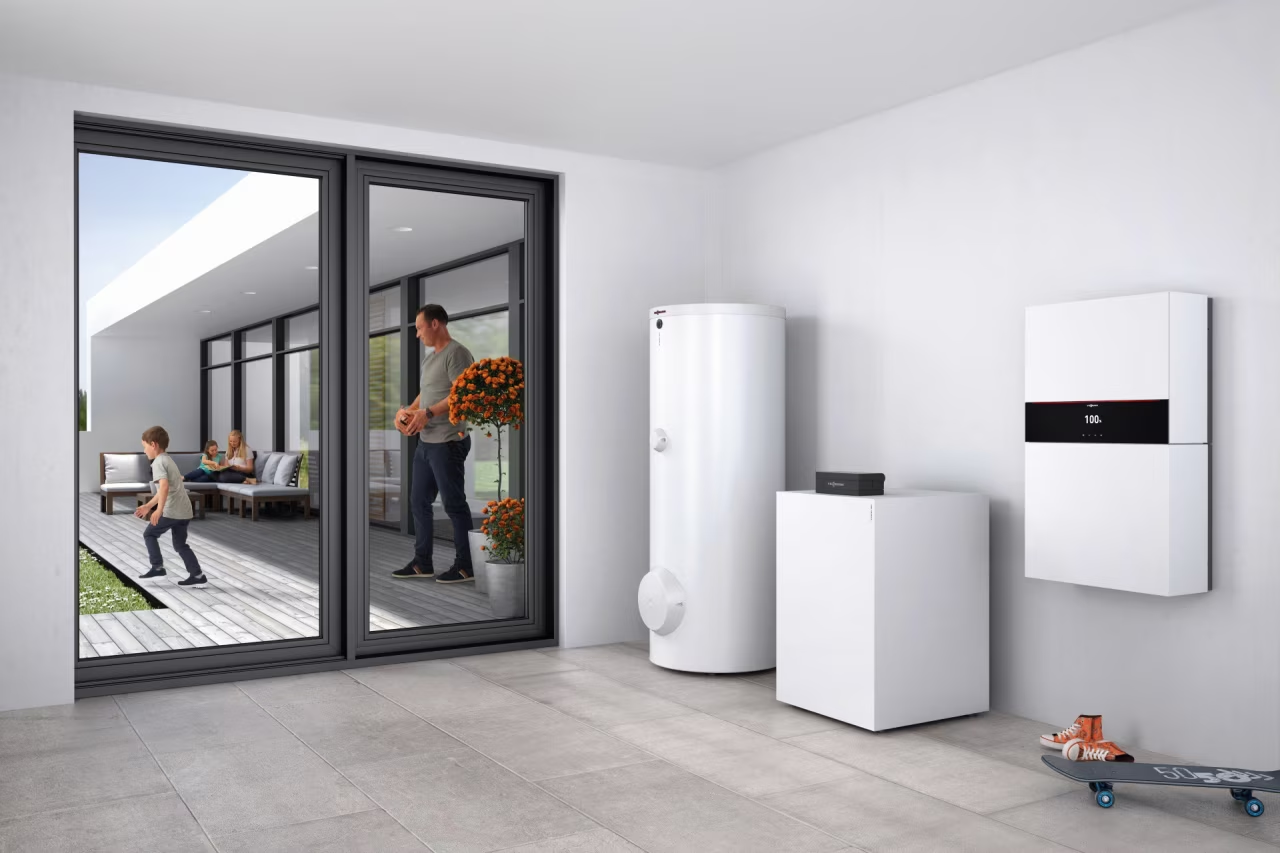
Brine/water heat pump
[1] Vitocal brine/water heat pump
[2] DHW cylinder
[3] Heating water buffer tank
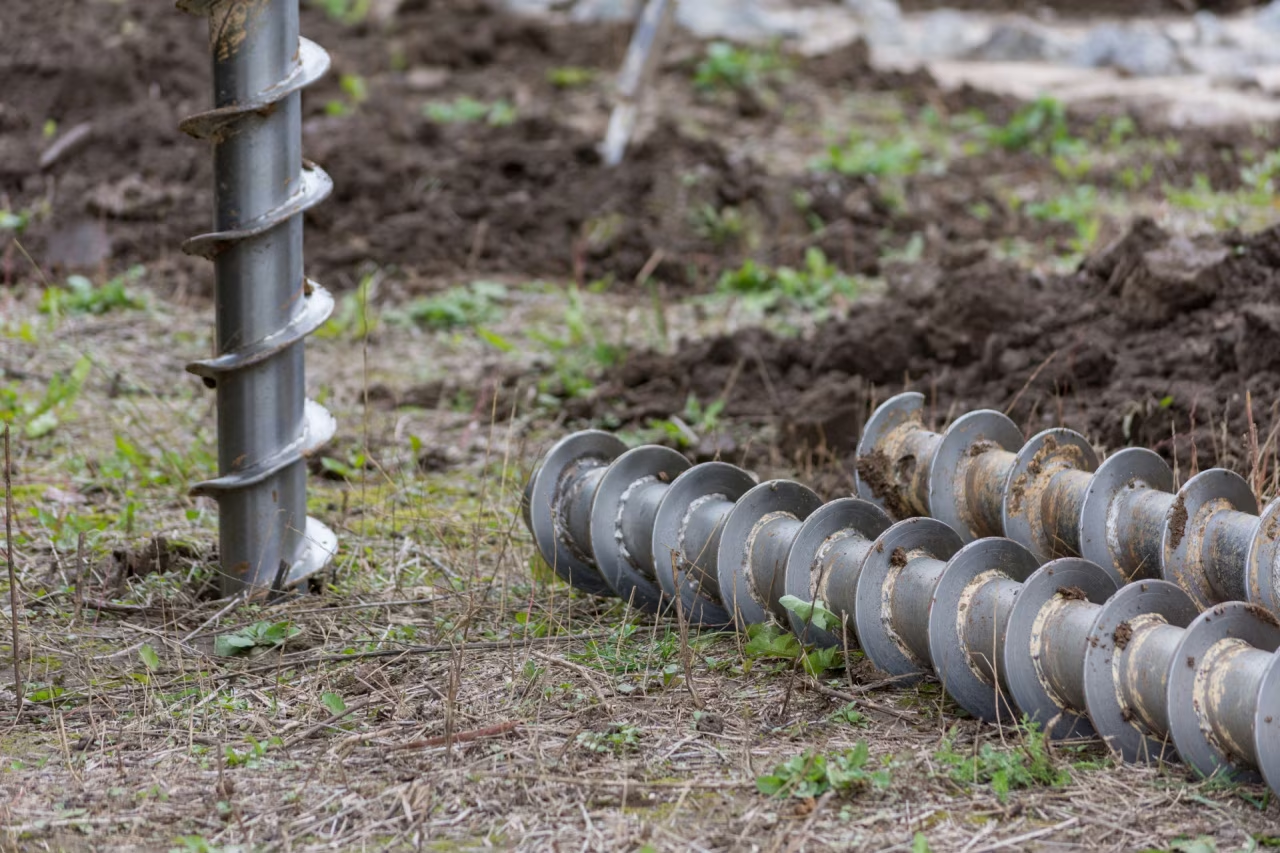
Geothermal probes extract heat from deeper layers of the earth.
An alternative to geothermal collectors are geothermal probes. Using boreholes, geothermal probes are sunk vertically or at an angle into the ground. Brine flows through them, absorbing geothermal heat at a depth of 40 to 100 meters and transferring it to a heat exchanger. At a depth of approximately ten meters, the temperature remains constant year-round, so geothermal probes operate efficiently even in very low outside temperatures. They also take up little space compared to geothermal collectors and can be used for summer cooling. The depth of the borehole also depends on the heat demand and the thermal conductivity of the soil. Since a borehole up to 100 meters deep penetrates several soil-bearing strata, drilling a geothermal probe always requires permission.
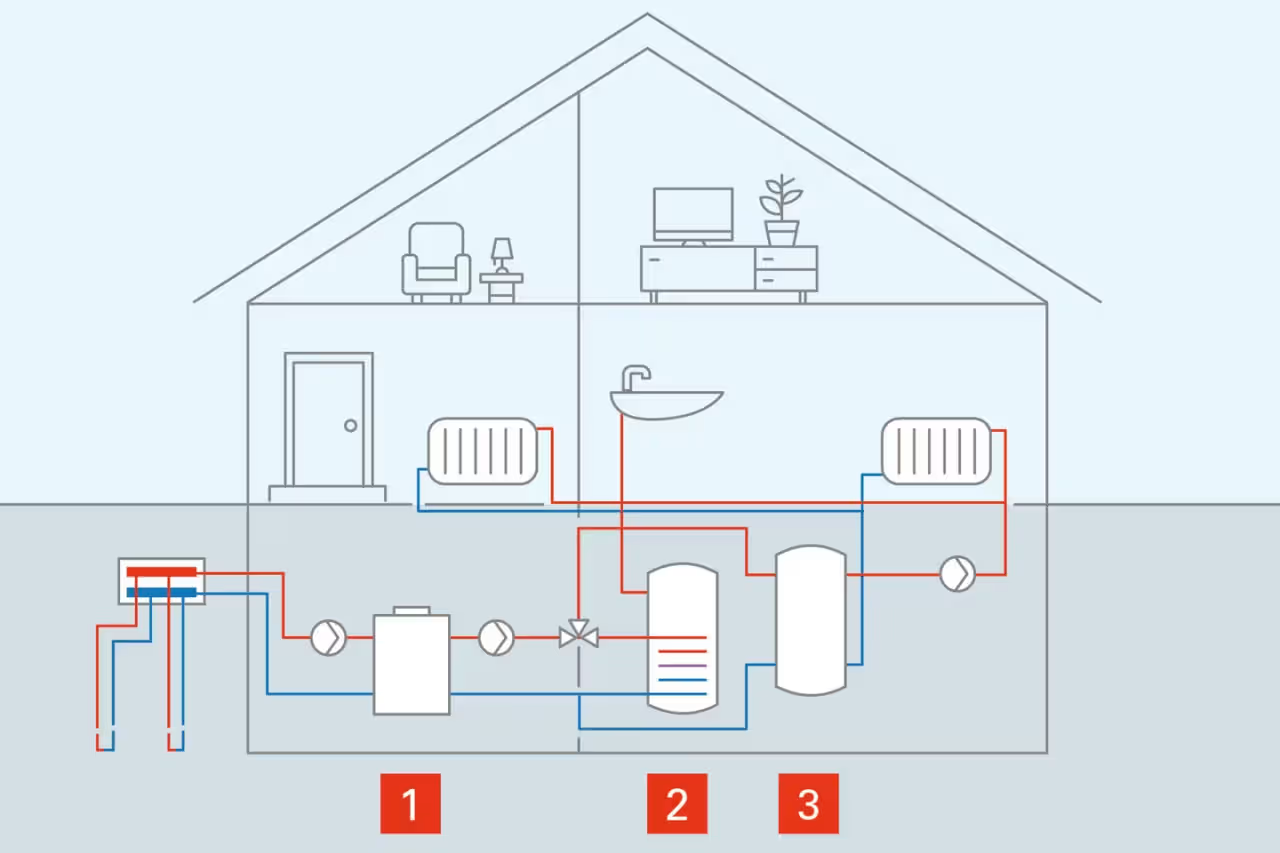
Heat from the earth (probe)
[1] Vitocal heat pump
[2] DHW cylinder
[3] Buffer tank for heating water

Heat pump expert advice
Free and No Obligation:
Get a free, personal, no-obligation consultation on our heat pumps from our qualified sales partners!
Request a consultation now →Advantages of a brine/water heat pump
There are many ways to combine business with pleasure. One such option is a brine/water heat pump. Using geothermal energy, a brine/water heat pump is an efficient heating method. Geothermal energy is the thermal energy found beneath the earth’s surface, which can be used as a heat source for a ground-source heat pump. In addition to attractive government subsidies, the advantages of a brine/water heat pump are numerous. They can be broadly divided into environmental and economic:
Economic benefits of a brine/water heat pump
One of the main advantages of a brine/water pump is the fact that the heat source is available virtually free of charge. The only energy required is to power the compressor. A combination with a photovoltaic system, which converts solar radiation into electricity, is ideal here. A virtually unlimited heat source also helps ensure that the price of raw materials is not subject to economic or political fluctuations. This significantly reduces system dependency on fuel suppliers. A ground source heat pump can operate economically in both single and dual mode. This means that the heating system can use one or two different heat generators to generate heat for space heating and/or domestic hot water.
Investing in the future
Investing in a ground-source heat pump also means investing in the future. This is because geothermal collectors and probes have a very long service life. Furthermore, these units require little maintenance, as they contain only a few moving components. Design and installation are typically handled by a heating contractor, ensuring safe operation from the start.
Passive cooling function with brine/water heat pump
During warm summer months, a brine/water heat pump can also be used for moderate heating. This transfers heat from the room to the geothermal probe system via underfloor heating. The ground then accumulates the heat for use during the next heating season. In this mode, only the circulation pump and control unit operate, making free cooling an energy-efficient and cost-effective method of cooling buildings. This process is described in more detail in the section ” Natural and Active Cooling .”
Environmental benefits of a brine/water heat pump

Beyond the economic benefits, there are numerous environmental reasons to use a ground source heat pump. This is because the energy needed for heating is climate-friendly and available directly beneath your property. This completely eliminates long, CO₂-intensive transport routes. Using geothermal energy also reduces harmful CO₂ emissions. Compared to gas or oil heating systems, up to 90 percent less flue gas enters the ozone layer.
Achieving energy transition goals with geothermal heat pumps
Brine/water heat pump operation offers another positive effect in addition to the advantages already mentioned: Experts see great potential for achieving the climate goals set by the German government. The key term here is “sector coupling,” i.e., the unification of electricity and heat markets. The foundation for this vision is the ever-increasing share of clean electricity. Wind and photovoltaic systems already produce so much electricity that they must be temporarily shut down to avoid destabilizing the power grid. Many experts are looking to find ways to utilize this excess energy using heat pumps.
The advantages of the AHI-Carrier ground source heat pump at a glance
Using a AHI-Carrier ground source heat pump offers numerous advantages. The most important include:
- A free source of heat available at any time of the day
- Efficient operation even in winter thanks to constant high temperature
- Can be used for natural cooling in summer
- Reducing CO₂ emissions into the atmosphere
- High government subsidies
Brine/water source heat pumps for commercial and local authority use
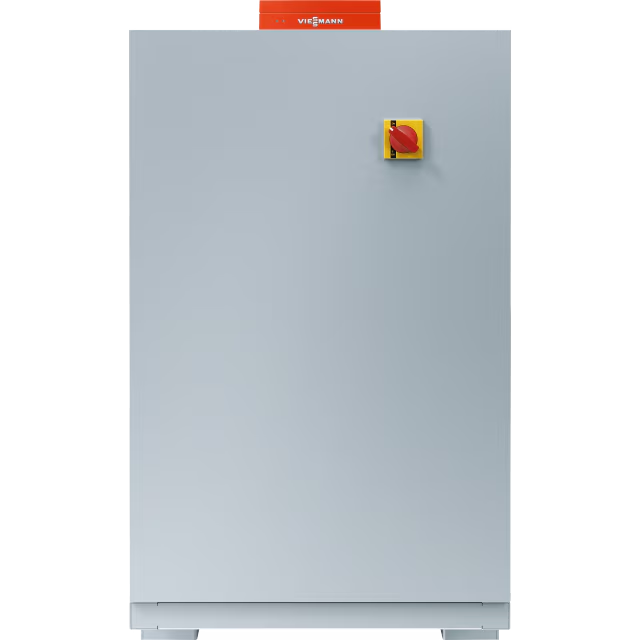
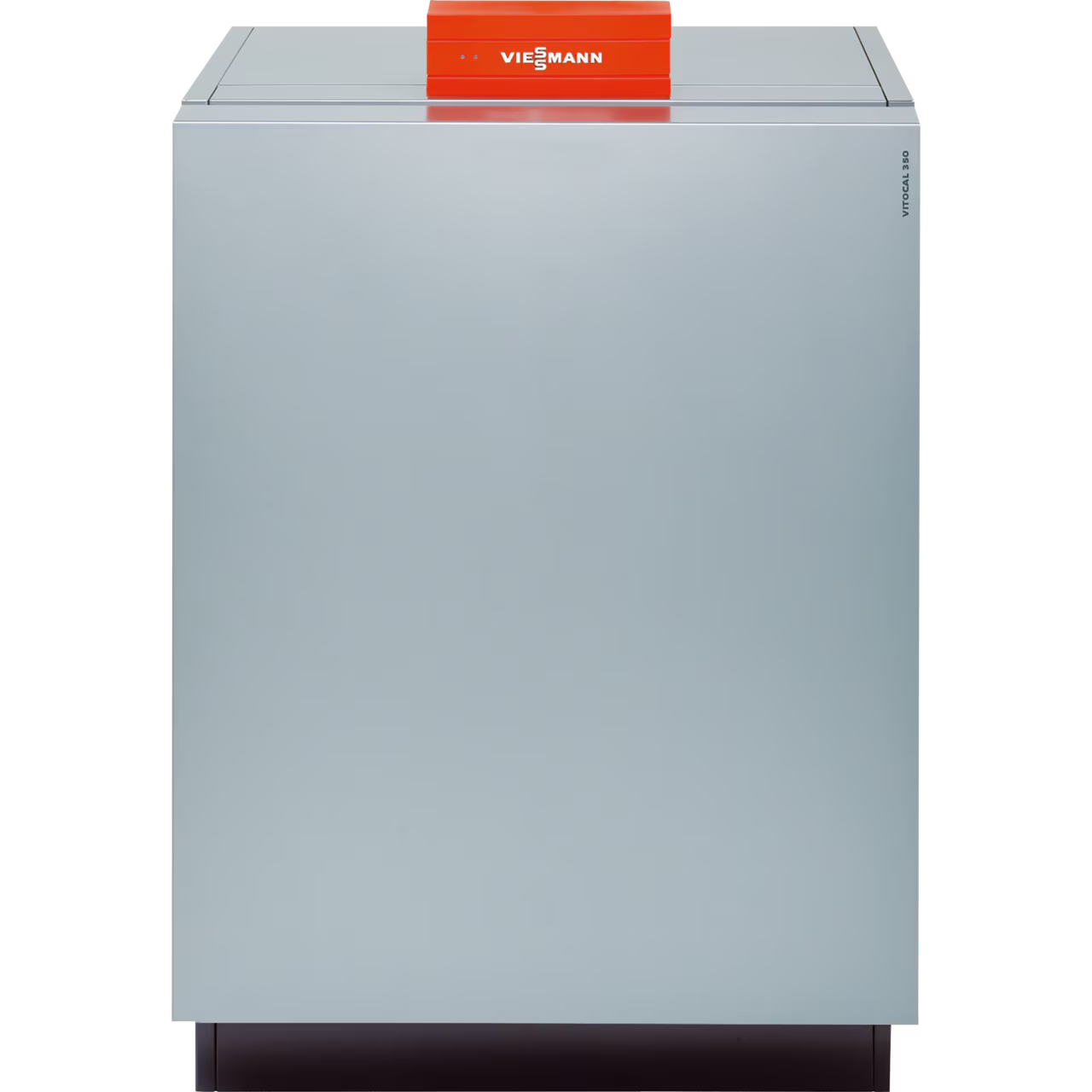
Brine/water source heat pumps use the ground as their primary energy source. They utilize geothermal collectors or geothermal probes, which are inserted into the ground to extract the heat stored there. Brine/water source heat pumps for commercial and local government applications are environmentally responsible and significantly reduce the cost of generating heat and hot water for domestic use.
| Vitocal 300-G | Vitocal 350-G | |
|---|---|---|
| Nominal heating power | Single-stage: 21.2 - 42.8 kW; two-stage: 42.4 - 85.6 kW, | 20.5 - 84.6 kW |
| Scope of application | Multi-family homes, commercial establishments, local governments, new construction and renovation projects | Detached homes, semi-detached homes, multi-family homes, commercial properties, local government, new builds and renovations |