Protecting resources, reducing CO2 emissions, and increasing the use of climate-friendly technologies are also goals that guide industrial processes and ensure the continued viability of projects. Optimal, environmentally necessary, and relevant steps also pay off economically. To this end, AHI Carrier offers future-oriented energy-based system solutions – including for industrial/commercial boiler systems.
The growing importance of environmental awareness in industrial processes
In 2015, an agreement was reached at the Paris Climate Conference, attended by 195 countries. The fundamental goal is to limit global warming to no more than 1.5 degrees Celsius. To achieve this, the global economy must transform itself in an environmentally responsible manner. For this to be successful, every sector must participate. All private and public investments must support the implementation of climate goals.
The German Federal Ministry for Economic Affairs and Energy emphasizes that Germany must undergo fundamental changes in its energy supply. This requires abandoning nuclear power and fossil fuels in favor of renewable energy sources.
Therefore, it is also important for industry to switch to renewable energy sources, reduce its use of fossil fuels, and, above all, reduce CO2 emissions. One possibility is to use energy for heating.
Using excess electricity to generate steam and heat
Wind and solar energy are increasingly integrated into the electricity grid. However, this means peaks in production, i.e., excess electricity at certain times. These peaks must be utilized for both environmental and economic reasons. When used as thermal energy, this energy can be used, among other things, to generate heat and steam in industry. The process of converting energy into thermal energy is becoming increasingly important as a hybrid energy storage system during the energy transition. This not only utilizes excess electricity but also conserves fossil fuels and reduces CO2 emissions.
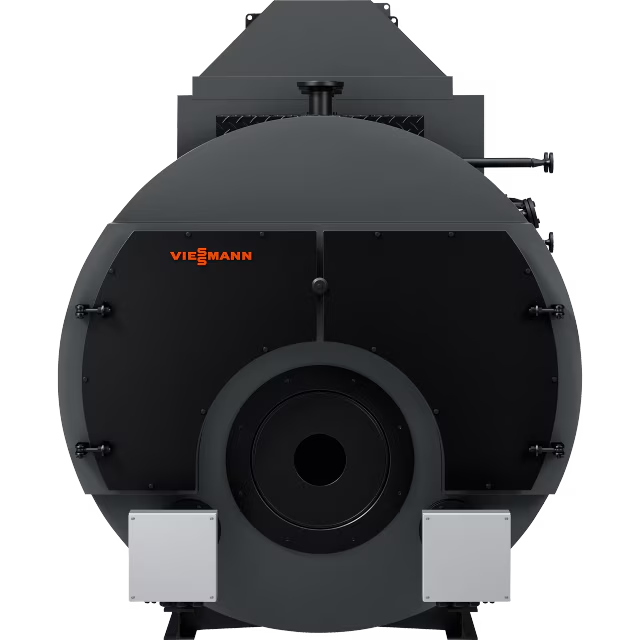
With AHI Carrier, you’ll have a reliable partner in this field as well. For industrial applications, we offer electric and hybrid boilers in standard power ranges, as well as custom-designed boilers.
Electricity use – how is it technically implemented?
Electric and hybrid boilers use excess electrical energy to generate saturated steam or heat. This is achieved through flanged radiators located within the boiler, which are designed as cartridge heaters and attached to the boiler via fittings. Cartridge heaters are highly resistant to corrosion and mechanical stress. Furthermore, depending on requirements, various immersion lengths of up to 4.5 meters are available. This allows for optimal use of electrical energy for steam and heat production.
Benefits of Electric Power Generation
In addition to reducing CO2 emissions and fossil fuel consumption, electric steam and hot water boilers offer other advantages. Specifically, they save money by reducing emissions taxes. Furthermore, less fuel needs to be purchased and stored. In fact, all-electric boilers eliminate this need entirely. Furthermore, cartridge heaters make it easier to maintain heat in the boilers in standby mode. This reduces the overall burner cycle time and helps minimize wear.
Both hybrid and all-electric boilers also use low-cost electricity. This can be electricity from a night tariff or excess electricity generated independently. Operating costs can be reduced in both cases. Both options feature high efficiency and a wide operating range. More detailed information can be found on the hybrid boiler and all-electric boiler pages.


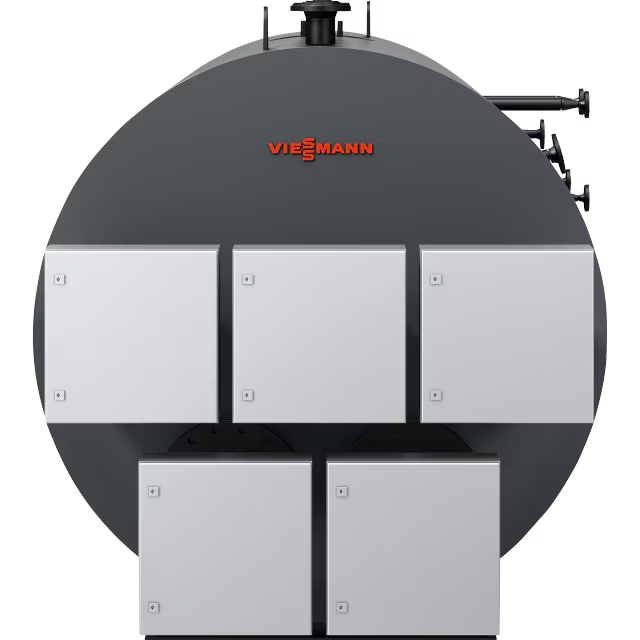
 Performance range: 0.5 - 5.0 t/h
 Low operating costs
 Fast cold start
 No flue gas emissions