

Topics at a glance
A heat pump utilizes natural energy in a particularly efficient and environmentally responsible manner: energy is extracted from the surrounding air, soil, or groundwater using a heat exchanger and raised to a temperature suitable for heating in the heat pump circuit. Harnessing this free natural energy means you no longer rely on oil or gas. Furthermore, your investment pays for itself in just a few years.
When it comes to choosing the right heating system for new buildings, home builders are increasingly turning to heat pumps. According to the Federal Statistical Office, 32 percent of all residential buildings built in 2016 were equipped with heat pumps. This development reinforces the misconception that heat pumps are only suitable for new buildings, which is not entirely true. Under certain conditions, using a heat pump in an older building can also be beneficial.
Heat pumps in old buildings
The new Vitocal 250-A and Vitocal 252-A air-source heat pumps make it easy to modernize heating systems, even in older homes. Innovations include a particularly climate-friendly refrigerant, a patented hydraulic system, and a new electronics platform with AHI-Carrier Energy Management.
Existing radiators can be used
The Vitocal 250-A is designed as a space-saving wall-mounted unit, while the Vitocal 252-A is a compact floor-standing unit with a built-in 190-liter hot water cylinder. These units, specifically designed for modernizing heating systems in detached and semi-detached houses, traditionally operate with R290 (propane), a refrigerant that is extremely climate-friendly compared to refrigerants used in other heat pumps.
This refrigerant also allows new heat pumps to achieve high flow temperatures of up to 70 degrees Celsius, even when the outside temperature is -15 degrees Celsius. In general, existing radiators can be used. Installing underfloor heating is optional, helping keep the cost of the upgrade within budget.
Cost-effective installation thanks to innovative hydraulics
Cost savings are also achieved by replacing an existing heat pump with a new one equipped with the patented Hydro AutoControl hydraulic system. It adapts to virtually all existing heating systems during retrofits and significantly reduces installation time compared to other heat pumps. Furthermore, the hydraulic system helps reduce the system’s footprint by two-thirds.

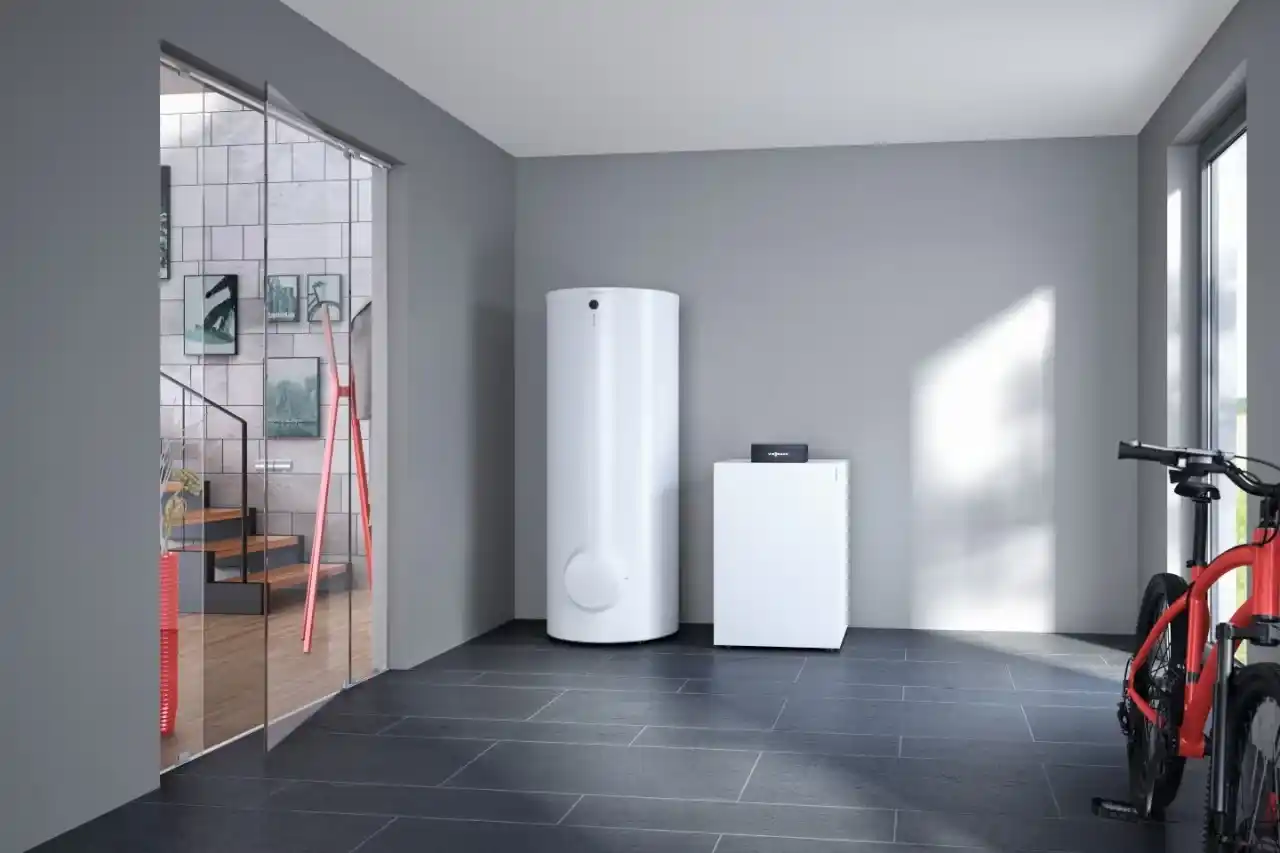
Vitocal 200-G can be used in both new and old buildings.
Heat pumps in new buildings
New buildings typically have good energy performance and, consequently, low heating requirements. Modern condensing boilers, which operate with high efficiency in the temperature range of 35 to 50 degrees Celsius, are typically used for central heating. Heat pumps are also one of the most widely used heating systems in new buildings. The reasons for this are obvious: heat pumps achieve the highest levels of efficiency in new buildings. Furthermore, a portion of the primary energy requirements in new buildings should be covered by renewable energy sources , which is easily achieved with a heat pump.
This is the quietest outdoor unit of its kind to date.
The new Vitocal outdoor unit boasts excellent workmanship and product quality. It impresses with its quiet operation thanks to its improved acoustic design. These units are particularly suitable for densely populated areas.
Operation of heat pumps with a photovoltaic system
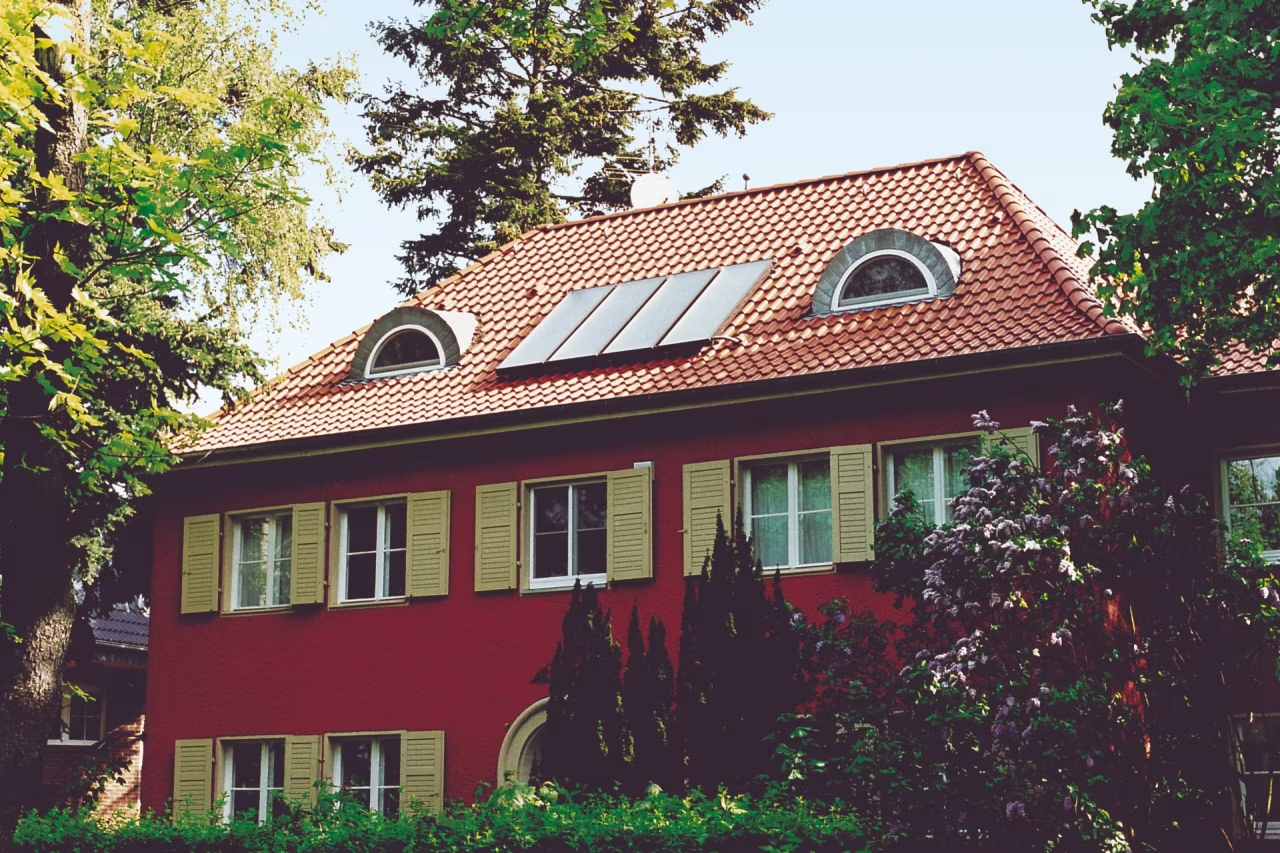
A photovoltaic system is also a good way to utilize free energy from the environment. Photovoltaic systems absorb solar radiation using an absorber and then convert the solar energy into electricity. Depending on the orientation, collector type, and global radiation, a photovoltaic system can cover a significant portion of a home’s electricity needs. When combined with a heat pump, solar energy can be used to circulate the refrigerant. This helps make the system’s users more independent of electricity providers. Furthermore, this combination means a near-zero carbon dioxide footprint, which is very beneficial for the environment. The heat pump itself is equipped with an intelligent PV optimization function that allows for the optimal use of self-generated solar energy.
A combination of a heat pump and photovoltaics can also be beneficial for homeowners seeking to achieve low-energy home standards. This is because the German Energy Saving Ordinance (EnEV) allows self-generated energy to be deducted from the final energy requirement. This reduces annual primary energy requirements and qualifies homeowners for attractive government subsidies for heat pumps in new construction.
Whether a heat pump is used in a new or existing building, to ensure reliable and cost-effective operation over the long term, the heating system must match the heating demand as closely as possible. The section ” Buying a Heat Pump ” explains what homeowners should consider when considering such a purchase.
Mechanical ventilation with heat recovery
For those living and working in enclosed spaces, controlled air exchange is essential. Controlled mechanical ventilation ensures a comfortable indoor climate, reduces heat loss during ventilation, and lowers heating costs. Ventilation units recover up to 98 percent of the latent heat in exhaust air, using it to warm incoming outside air. When combined with a Vitocal heat pump, this creates a complete air conditioning system.
Other AHI-Carrier guides and tips

In what case is it advisable to use a combined heat and power plant
For the KU module to be economically viable, the device must operate continuously for as long as possible. Read here to learn why this makes sense.