
AHI-Carrier Vitocal 100
Topics at a glance
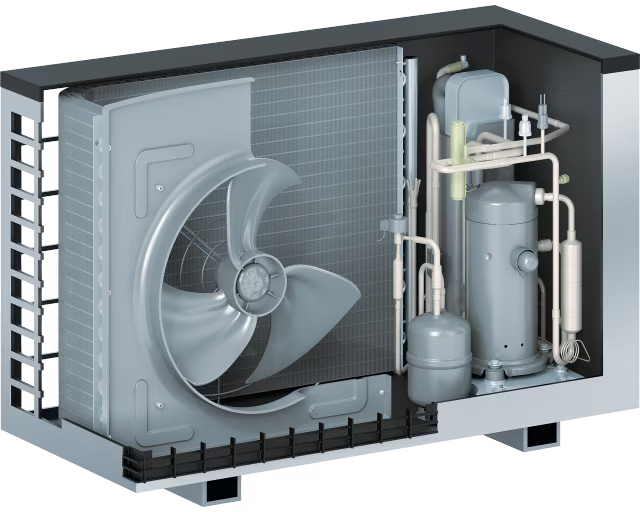
Heat pumps generate heat using the principle of compression, whereby the evaporated refrigerant is compressed and its temperature is raised to the required level. This can generate noise, which, if exceeded at a certain level, can be perceived by some as irritating.
Technical instructions for noise protection as a basis for design
Air-source heat pumps also utilize active heat recovery using fans, a process that also generates noise. Since noise perception is highly subjective, a design basis is necessary. This is provided by the Technical Instructions for Noise Protection (TA Lärm), which are in turn regulated as an administrative regulation by the Noise Protection Act (BImSchG).
Accordingly, there are several areas in which different levels must be maintained. For example, if a system is used in an industrial area, the noise level may reach 70 decibels (A). However, if the same system is intended for use in a hospital or nursing home, the limit of 45 decibels (A) during the day and 35 decibels (A) at night cannot be consistently exceeded.
Estimated emission values
The following table shows guideline values for noise penetration points outside buildings in accordance with the Technical Instructions for Noise Reduction (TA Lärm).
| City | Time | Limit in dB(A) |
|---|---|---|
| Industrial zone | all day | 70 |
| Shopping areas | Day Night |
65 50 |
| Urban areas | During the day | 63 |
| Urban areas, villages and mixed areas | Day Night |
60 45 |
| General residential areas and small residential complexes | Day Night |
55 40 |
| Purely residential areas | Day Night |
50 35 |
| Resort areas, hospitals and nursing homes | Day Night |
45 35 |
Individual short-term noise peaks must not exceed the immission directive values by more than 30 dB(A) during the day and by more than 20 dB(A) at night.
Emission values for indoor use in buildings or rooms requiring protection, according to DIN 4109, are significantly lower and amount to 35 decibels (A) during the day and 25 decibels (A) at night. Rooms requiring protection include:
- Living rooms and bedrooms
- Children’s bedroom
- Workrooms/offices
- Classrooms/seminar rooms
The kitchen where the occupants live must also be regarded as a room requiring protection in the sense of No. A.1.3 TA Läärm (in conjunction with DIN 4109, November 1989 edition).

Heat pump expert advice
Get a free, personalized consultation on our heat pumps from our qualified sales partners!
Request a consultation now →Low frequency sounds are considered irritating.
In addition to complying with legal noise levels, reducing low-frequency sounds is an important approach. Many people find them annoying, even if the sound level (i.e., volume) is below the legal limit. Low-frequency sound is a term used to describe the portion of noise with a frequency below 90 Hz. Humans begin to perceive sounds in the range of around 20 Hz.
The reason low-frequency sounds are still perceived as irritating is partly because these sounds are only perceived at higher volumes. Furthermore, humans cannot distinguish sounds in this range, so low-frequency sounds are commonly referred to as “hum.”
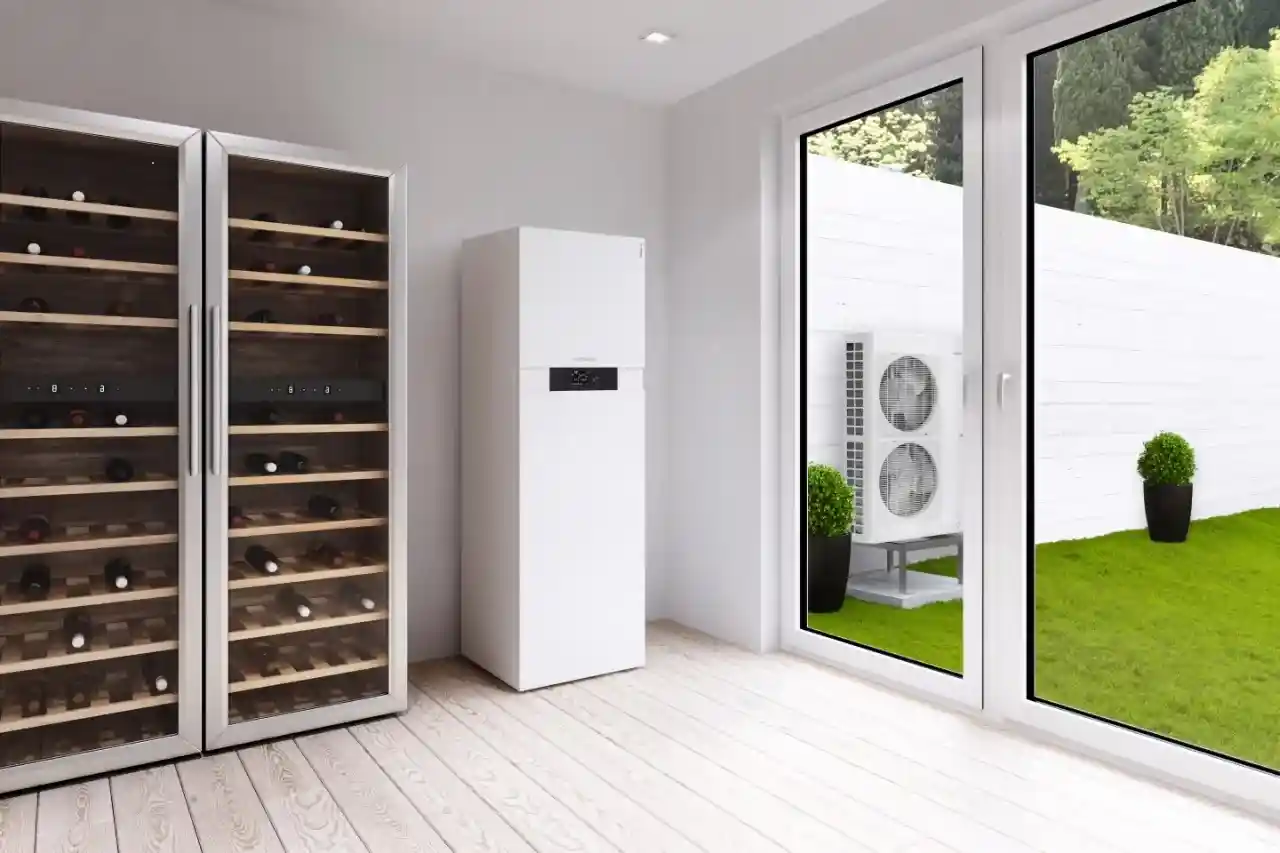
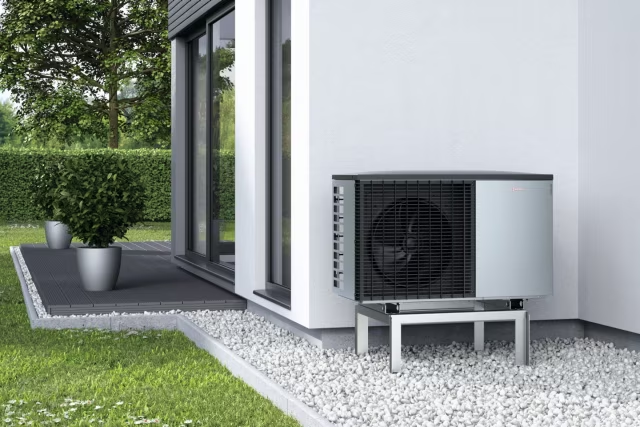
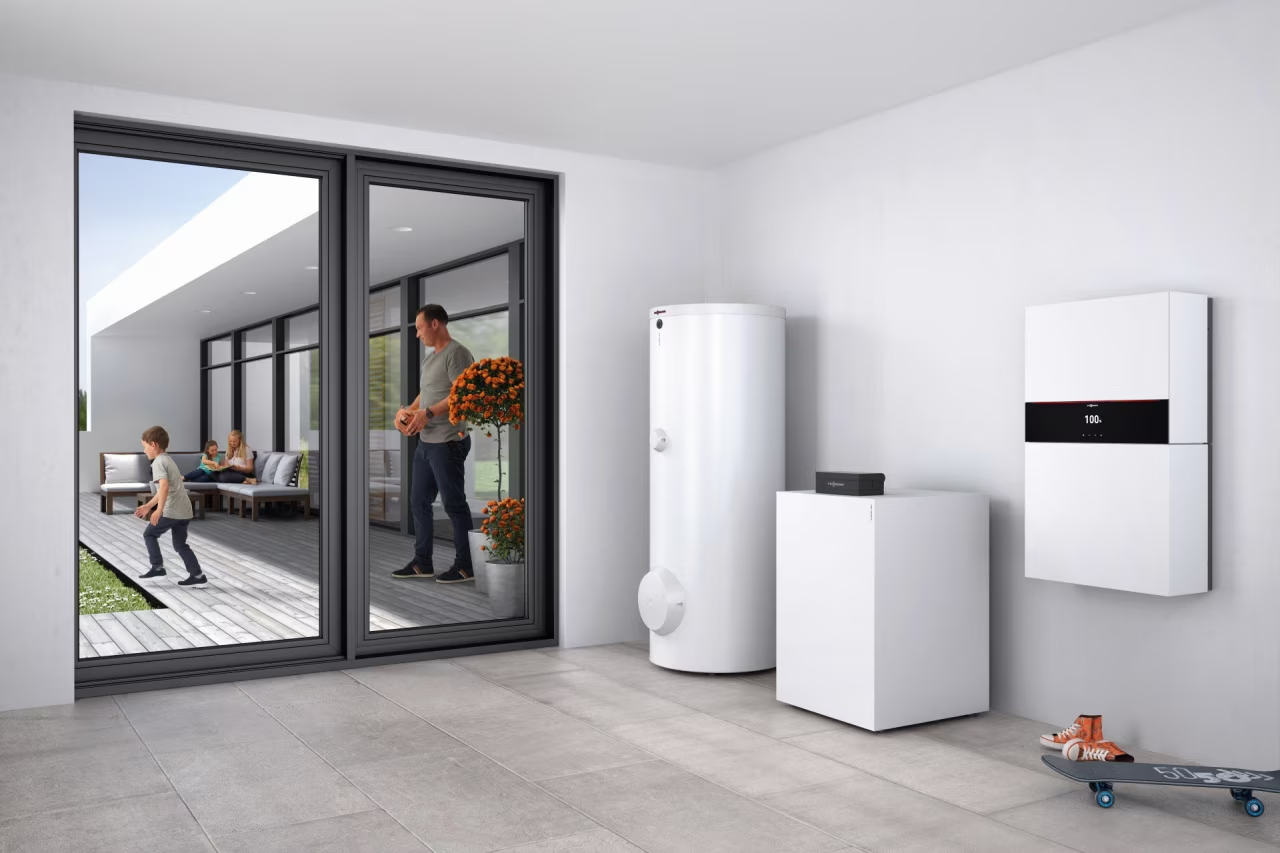
Due to the separation of the outdoor and indoor units, air-source heat pumps are virtually silent. (Vitocal-111-S)
Noise reduction thanks to the AHI-Carrier heat pump design alone
As noise issues become increasingly important, AHI-Carrier has implemented numerous design measures to minimize the noise level, or volume, of its heat pumps since 2009. When developing our heat pumps, sound specialists and refrigeration circuit designers work hand in hand to create highly efficient and quiet heat pumps. In addition to the 3D sound concept, this also led to the development of the AAD (Advanced Acoustic Design) system, which arguably makes AHI-Carrier heat pumps the quietest on the market.
AHI-Carrier air-source heat pumps are among the quietest units on the market.
AHI-Carrier air-source heat pumps are among the quietest units on the market. You can learn more about what makes them special in the section on the advantages of air-source heat pumps . The noise level of individual heat pumps depends, among other things, on their efficiency and the distance from neighboring buildings.
The German Heat Pump Association’s sound calculator can serve as a reference. It helps homeowners determine the potential noise emissions of listed air-source heat pumps with a heating capacity of 35 kilowatts or less. In addition to emission data, the sound calculator also calculates the distance to adjacent rooms requiring protection. The results obtained are not a substitute for an individual noise level assessment, but they nevertheless provide a very useful basis for planning.