

© Shutterstock / Yevgeniy
Saving Gas – Reduce Gas Consumption with Simple Tips
Whether it’s energy crises, the global political situation, or the desire to use natural gas in a resource-saving manner, the motivations for saving gas are varied. The solution begins with an analysis of your heating habits and daily activities and ends with a well-planned modernization of your heating system. In the following guide, you’ll find a variety of tips, from simple ones that can be implemented in the short term to more complex ones. However, don’t shy away from these last tips. With the right AHI Carrier partner at your side, modernization and the transition to new energy sources, as well as combinations with renewable energy solutions, are also possible.
Some simple tips to reduce gas costs
To reduce gas consumption and, consequently, costs in the short and medium term, it’s best to start with your heating habits. Reducing the temperature by just one degree without additional measures in an existing building reduces consumption by six percent. But this doesn’t mean you should sit in the cold. Optimal temperatures based on the use of the premises are crucial. The following values can be used as a guide. However, individual circumstances should always be taken into account.
- Living room: 20 to 22 degrees Celsius
- Bedroom: 16-18 degrees Celsius
- Hallway and kitchen: 18 degrees Celsius
- Children’s bedroom: 22 degrees Celsius
- Bathroom: 23 to 24 degrees Celsius
To correctly set the temperature on a classic radiator with a thermostatic head and a 5-stage scale, we recommend the guide ” Correct thermostat installation “.
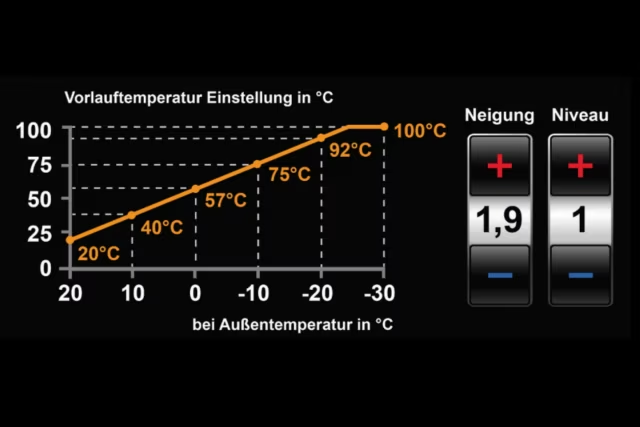
It can also be useful not only to set the optimal temperature for each room and thereby save gas, but also to optimize the entire heating circuit. This allows you to adjust the heating curve . It’s also useful to select different heating programs, such as summer mode or night setback . The best way to do this is described in the operating instructions, which you can find in the ViBooks section. Alternatively, ask your local installer for instructions.
Maintenance and purging of the heating system
However, it’s important to consider not only the optimal room temperature but also the ideal heat distribution within the heating system. To ensure this, regular maintenance is essential. It’s best to schedule maintenance during the warmer months. During these times, less heating is required, and any repairs don’t impede living comfort as much as during the heating season , making this period a good time for an annual system inspection. This may include additional adjustments to the heating system controls to reduce gas consumption at the central point.
In addition to maintenance, you can also help ensure optimal heat distribution in your heating system. Bleeding your radiators may be necessary, especially after long periods of inactivity, such as after summer. Air bubbles can accumulate in hot water in various ways. These can not only cause annoying noises in your heating system but also uneven heat distribution. Radiators often remain cold at the bottom, and sometimes even entire rooms cannot be heated properly. In this case, bleed-out heating systems are recommended .
Tip: Optimal heat distribution in the room can also be ensured by ensuring that radiators are not obstructed or covered by long curtains or drapes. Most importantly, do not cover the thermostat’s temperature sensor.
AHI Carrier explains: Blowing out the heating system
Other reference books
Insulation and draft protection to save gas
Particularly in existing, older homes, it’s important to pay attention to the insulation and draft protection of windows and doors, as well as the insulation of heating pipes. For doors and windows, you can use insulation tape, weatherstripping, or draft barriers. Exposed heating pipes can lead to significant heat loss before it reaches the living space, and basements and other rooms can become excessively warm. Particularly if the distance between the heat generator and the radiator is relatively large, it’s worth taking a closer look. During a heating inspection or heating system maintenance, you can review these issues in more detail with an expert on-site and discuss possible solutions.
Saving gas when heating domestic hot water
In addition to heating energy, a gas heating system also supplies households with hot water. Depending on the building type, the state of insulation, and the behavior of the occupants, the proportion of gas used to heat domestic hot water varies greatly. On average, it is up to 12 percent in older buildings. In newer buildings, this percentage can be much higher, as much less heating is used, but hot water consumption typically remains the same. Therefore, to save gas and, consequently, money, it is recommended to take showers rather than baths. An energy-efficient shower head can also be helpful. For more tips, see our guide to optimizing hot water consumption .
Don’t forget about optimal ventilation
Proper heating management also includes ventilation. Especially during the heating season, avoid slanted ventilation by keeping windows tilted. This leads to constant heat loss, forcing radiators to be positioned higher and higher. Furthermore, manual ventilation doesn’t ensure complete air exchange. Instead, alternate ventilation and cross-ventilation are recommended. Ideally, fully open opposite windows. A few minutes several times a day is sufficient. Also, remember to dim the radiators during these times. This will prevent heat from escaping, saving you on gas costs. An alternative to manual ventilation is a mechanical ventilation system . Depending on the type, the heat from the exhaust air can be used to heat the space.

Combining and upgrading to save gas
Beyond the numerous small steps that can be taken to reduce gas consumption, there are also technical opportunities to implement them on a larger scale. A gas heating system that is too old and no longer meets the latest technology, i.e., condensing technology, should be replaced. An existing gas condensing boiler can be supplemented with a heat generator powered by renewable energy. Ultimately, there’s also the option of switching completely to an alternative. In any case, in the long run, you’ll save gas and become increasingly independent of fossil fuels. This not only conserves resources but also has a positive impact on both your energy costs and your carbon footprint.
Supporting a gas heating system with solar energy and other possible combinations
A solar thermal system, which uses free solar energy to heat hot water and/or support the central heating system, is considered an optimal complement to a gas heating system. You can supplement an existing system or plan a new one using solar technology from the start. Learn more in the Gas and Solar Heating section .
A gas heating system can also be combined with any other renewable energy solution—pellet heating, wood heating in general, heat pumps, and fuel cell heating systems. A very popular combination is a gas heating system and a heat pump. In this case, the gas heating system acts as a peak-load boiler when heat demand is higher than normal or the outside temperature (when using an air-source heat pump) is very low.
Modernization of the gas heating system and the choice of alternative options
A significant portion of heating systems installed in Germany are outdated. To save gas, it is recommended to use the latest condensing technology, which utilizes up to 98 percent of the energy contained in the fuel by recovering the heat hidden in the flue gases. When upgrading, hybrid systems should always be considered for additional gas savings.
Another option is to switch completely to an alternative to gas heating systems . This way, you don’t just use less gas, you don’t use it at all, and you become independent of price fluctuations. This makes it easier to plan your ongoing expenses. It also helps save fossil fuels. In the long run, you’ll also reduce your energy costs.