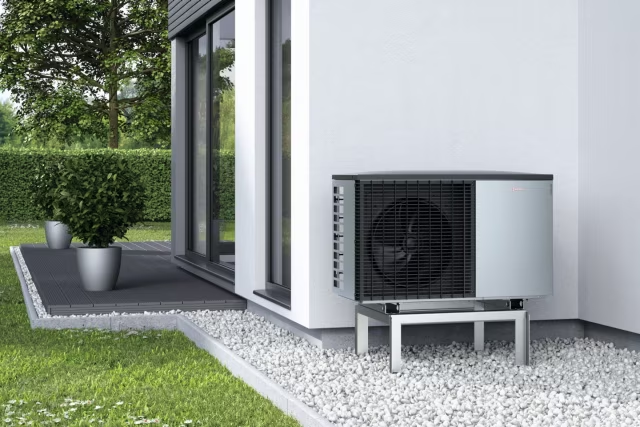
Purchasing a new heating system
We’ll explain what’s important when purchasing a new AHI Carrier heating system and provide some tips to help you choose the system that’s right for you.


(Photo: © A_Lesik / Shutterstock.com)
District heating networks transport heat from central heating plants to consumers in nearby areas. Particularly in densely populated areas, they heat individual buildings, as well as neighborhoods and entire districts. The use of industrial waste heat and the potential for the increasing use of renewable energy sources for heat production make district heating a key lever in the energy transition. But what exactly is district heating, what costs should be expected, and what advantages and disadvantages should district heating consumers be aware of? Learn more in the following guide.
District heating is produced in a variety of ways. In most cases, however, it is a waste product of other processes. This waste heat can be effectively used, for example, in waste incineration plants or in electricity generation at large combined heat and power plants (CHPs). This heat is transported to consumers through district heating pipes laid above or underground. Households connected to the district heating network do not need their own boiler. In most cases, domestic hot water is also heated by the district heating system. Hot water is predominantly used as the heat transfer medium. It circulates in a closed system and transfers the heat energy to district heating transmission stations and the local heating system of connected buildings.
Local heat supply also operates on the same principle, but local heating networks transmit heat over relatively short distances. Furthermore, small heating substations are typically used. Heat is generated, for example, by large biomass boilers, medium-sized combined heat and power plants, large heat pumps, or a combination of these. However, depending on regional conditions, industrial waste heat can also be used.
District heating cannot always replace domestic heating. A key requirement is that the building be located within the district heating supplier’s service area. These are primarily concentrated in urban areas. For the cost of installing heating networks to be economically justified, it’s essential to have as many consumers as possible. Connection to district heating is also possible in densely populated areas of new development or as an additional heat source for industrial or commercial consumers. As mentioned, a thermal interface unit is required for district heating to function. However, the construction work for the building is quite feasible.
We’ll explain what’s important when purchasing a new AHI Carrier heating system and provide some tips to help you choose the system that’s right for you.

With the right measures and our professional advice, you can easily save energy and reduce your heating costs.

What heating technologies exist and under what circumstances are they suitable? Find out which heating system is best for your project.
Governments rely on district heating, in particular, to achieve ambitious climate goals. The efficiency and sustainability of district heating depends on a number of factors. Important factors include:
Thermal energy for district heating networks is almost always produced as a byproduct, for example, from waste incineration. Without appropriate use, this energy remains unused, and resources are wasted. Combined heat and power (CHP)—the combined production of electricity and heat—also plays an important role in connection with district heating. This is because power plants primarily produce electricity. By additionally utilizing the heat generated in the process, energy efficiency can be increased to 80 percent. The efficiency with which resources are used also depends on losses in the network. In some cases, thermal energy must be transported over long distances to reach consumers, and heat loss can occur through pipes.
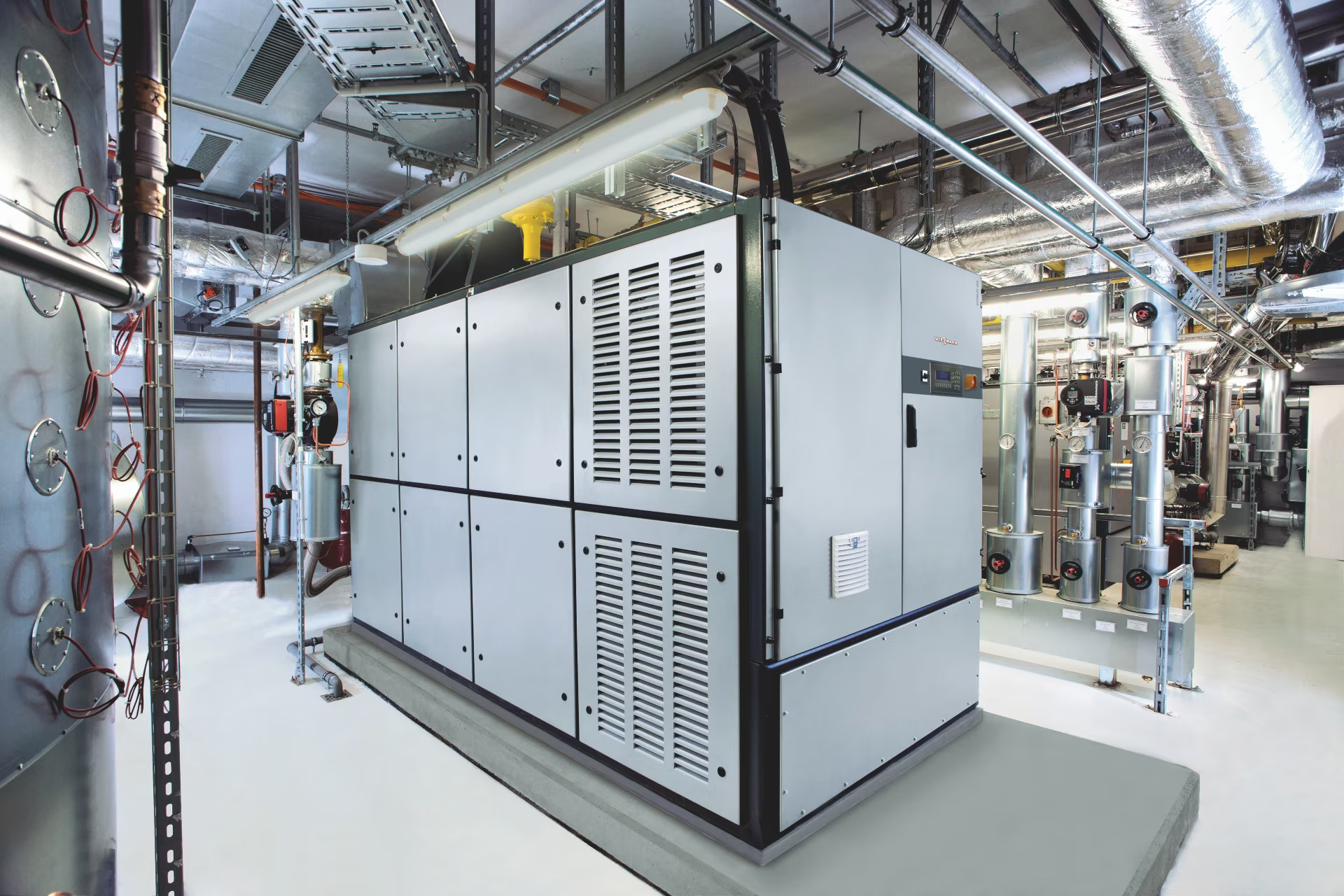
AHI Carrier Vitobloc cogeneration unit
Combined heat and power plants (CHPs) still primarily burn fossil fuels such as gas, lignite, and anthracite. However, thermal energy can also come from renewable sources such as biomass or geothermal power plants, large solar thermal systems, or heat pumps.
In anergic or cold heat networks, heat loss through pipes is lower. This is because, unlike traditional district heating networks, the coolant does not have a temperature of 80 to 130 degrees Celsius. Water has a temperature of only 10 to 25 degrees Celsius. This makes it suitable for both heating and cooling. Another difference is the type of heat transfer. It occurs not through a traditional thermal interface unit, but through a heat pump, which increases the temperature as part of the process. Cold district heating does not require the drilling of probes or boreholes or the necessary permits for a heat pump.

(Photo: © maeching chaiwongwatthana / Shutterstock.com)
It’s impossible to accurately determine how high district heating costs will be. In any case, district heating prices, or operating costs, consist of the following components:
District heating service providers combine the costs of network maintenance and upkeep, as well as staff and administration, into a base or commodity price. The price is fixed and depends on the level of connected load. The following rule always applies: the more consumers connected to the district heating network, the lower the base price. This is because the supplier can pass on the operating costs to more consumers. The commodity price is used to calculate how much heat is drawn from the network, thus depending on individual consumption. Additionally, some district heating service providers charge fees for services such as metering and billing. Due to various influencing factors, the price of district heating varies greatly.
Whether for a new or existing building, district heating has both advantages and disadvantages. Among the advantages is the fact that no boiler, flue system, or fuel is required. This reduces acquisition and maintenance costs to zero. The required heat interface unit also takes up relatively little space. Reusing heat that would otherwise be lost as waste is also fundamentally beneficial. If it comes from renewable energy sources, CO2 emissions are also reduced . However, it’s important to remember that connecting to the district heating network isn’t always possible. Even if all the necessary conditions are met, the choice is often limited due to connection restrictions. This also applies to the choice of supplier. This is because the operation of the network and heat generating units is handled by a single company. There is no competition. Consequently, there is little leeway regarding operating costs. These can vary greatly depending on the price calculations made by suppliers.
Renewable energy-based heat generators are a good alternative to district heating. Depending on specific circumstances, various heating systems may be suitable. Possible options include heat pumps or solid fuel boilers , such as pellet heating systems. Experts help find the right solution. They assess the local situation and provide tailored advice, whether for a single-family home or a residential complex.

Geothermal collectors for brine/water source heat pumps extract heat close to the surface and can be installed without a permit. You can read more about the differences here.