


Topics at a glance
Along with oil, gas is one of the most important primary energy sources in Germany. Industry isn’t the only one requiring large quantities of gas. This fossil fuel is also essential for heating homes and apartments. Official statistics demonstrate the importance of gas in the heating sector and confirm that gas systems are among the most commonly used heating systems. Around two-thirds of all heat generators use gas.
Gas as a driving energy and a primary fuel for heating systems
The most well-known type of heating system uses gas. It burns fuel, releasing heat. It can burn fuel not only in gaseous form but also in liquid form (liquefied gas). But this is far from the only type of heating that uses gas as an energy source. Combined heat and power plants, for example, burn gas to drive a turbine, which in turn generates electricity and heat. Heat pumps also use electricity or gas to drive a compressor. One special type of heating system is fuel cell heating. It also uses gas as an energy source to generate heat and electricity. But here’s the trick: the gas isn’t burned, but rather chemically separated. The fuel in this case isn’t the gas itself, but hydrogen, reformed from it.
Formation and reserves
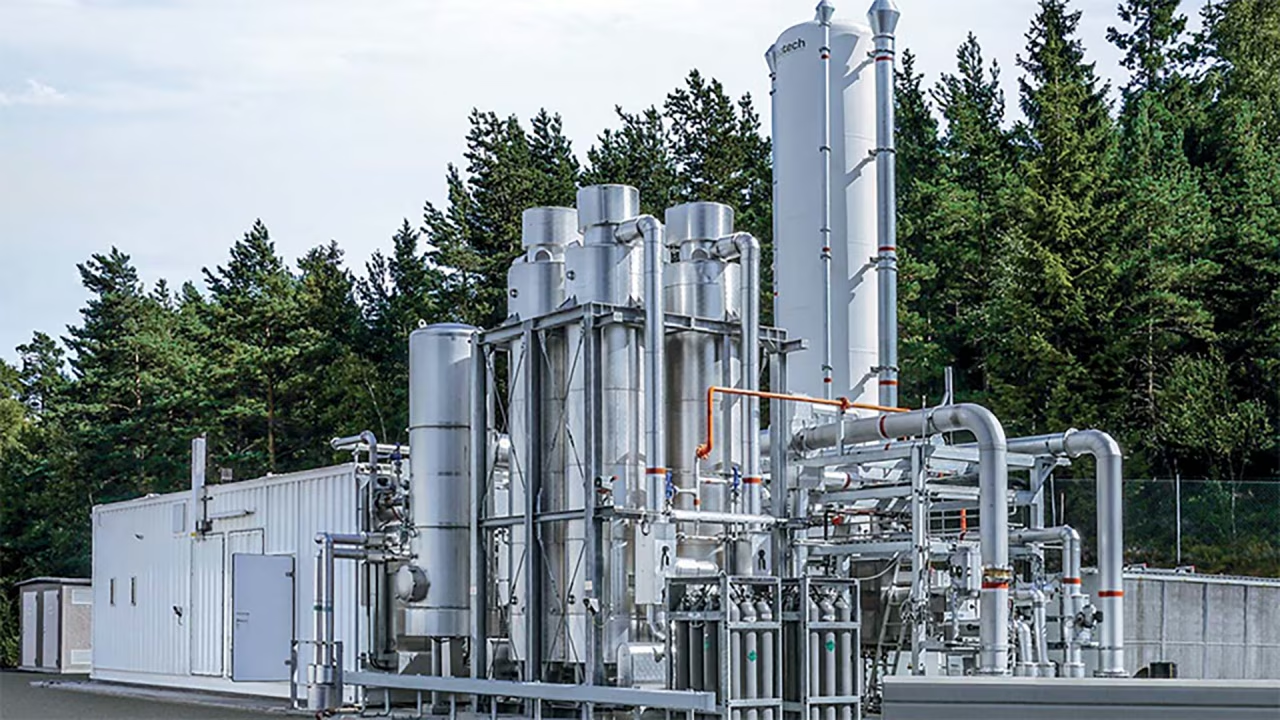
The figure shows a plant for processing gas into fuel.
Gas, in this case natural gas, is formed in a very similar way to crude oil. Both raw materials formed millions of years ago from organic matter and are found in deposits, some of which are enormous. Natural gas itself is a mixture of methane, nitrogen, and other hydrocarbons such as ethane, propane, and butane. It can also be extracted from deep underground using wells. Until a few years ago, natural gas was primarily flared as a byproduct of oil production. This not only wastes resources but also pollutes the environment in the long term. Since then, governments in producing countries have passed laws banning gas flaring.
Since primordial oceans covered most of our planet millions of years ago, natural gas is found in almost every region of the world. The Middle East holds the largest reserves, followed by Europe and Eurasia. However, the list of countries with the largest production volumes is topped not by Saudi Arabia, for example, but by the United States. Germany also has natural gas reserves of approximately 123 billion cubic meters. Production here is concentrated in Saxony-Anhalt. However, gas can also be extracted from renewable sources. Biogas, commonly known as biogas, is produced from biomass, such as corn, sugar beets, or other energy crops, in specially constructed plants.
Reserves and resources
When discussing whether gas supplies are guaranteed in the coming years, it’s important to distinguish between reserves and resources. Reserves refer to already discovered volumes, while resources refer only to those deposits that are not yet economically exploitable. A report by British oil company BP estimates that it will take 55.1 years for natural gas reserves to be completely depleted.
This assumes that consumption remains constant. The company used 2014 data as the basis for its calculations. That year, nearly 4,000 billion cubic meters of gas were consumed globally. Compared to existing reserves, the volume of resources that cannot yet be scientifically extracted is significantly greater. The German Association for Natural Gas, Oil and Geoenergy (BVEG) estimates that natural gas reserves will last for 260 years.

Expert advice on gas heating
Get a free, personalized consultation on our gas boilers from our qualified sales partners!
Request a consultation now →Benefits of using gas

Matrix gas burner
Using gas has many advantages for both the user and the environment. Thanks to its high energy content, system owners benefit from extremely economical heating – especially if the boiler uses condensing technology. You can read about what makes this technology so special in the section ” Advantages of Gas Condensing Technology .” One thing is certain: compared to other fossil fuels, gas burns very cleanly. It emits less CO₂ than, for example, crude oil, and produces virtually no pollutants such as nitrogen oxides or sulfur dioxide. This means less impact on the environment.
Industry also relies on this fuel. In particular, gas plays a significant role in electricity generation. Compared to traditional power plants, natural gas-fired power plants ramp up and down their output as needed. Therefore, they are often used to quickly and reliably balance peak loads. Another advantage is their well-developed distribution network.
Gas transition and gross calorific value
A transition from L-gas to H-gas is currently underway in northwest Germany. The costs are being borne by the gas utility and the German Federal Network Agency (Bundesnetzagentur). Owners of gas heating systems need to pay close attention to all letters, notifications, and deadlines they receive from their energy supplier. The purpose of this transition is to guarantee supplies and standardize the type of gas. This is because the gross calorific value, or energy content, of gas is not always constant. For L-gas, for example, it ranges from eight to ten kilowatt-hours per cubic meter. For H-gas, it ranges from ten to twelve kilowatt-hours per cubic meter. If you want to know the gross calorific value of the gas you buy, check your gas bill. This value is usually listed there. If not, it’s worth asking your gas supplier.
If you already have a Viessmann condensing boiler with the Lambda Pro Control intelligent control system, upgrading to the new system will not affect you. This is because the combustion controller automatically adapts to the gas quality and can easily burn energy-rich hydrogen gas. For more information, see the “Conversion to Gas” page.